- Linked dataset connects Inovalon claims data with OMNY Health EHR data to power real-world evidence research
- Combines claims data alongside structured and unstructured clinical records for a 360-degree view of the patient
- Real-world data offering helps researchers better understand disease progression and treatment response
BOWIE, Md. – August 11, 2026 – Inovalon, a leading provider of data and solutions empowering data-driven healthcare, and OMNY Health, a leading healthcare ecosystem for compliant real-world data (RWD) insights at scale, today announced a strategic real-world data partnership that combines Inovalon’s primary source closed claims data with OMNY Health’s EHR data and clinical notes. The dataset gives researchers and life sciences organizations a comprehensive view of disease progression, treatment patterns, and outcomes to support real-world evidence studies and help accelerate access to new precision therapies for patients.
The linked dataset includes 248 million lives in closed claims, 175 million lives in EHR data, and 7+ billion clinical notes, with more than 40% of lives linked across sources. Closed claims provide longitudinal visibility into care utilization and costs across providers, payers, and settings, while EHR data and clinical notes add the clinical depth behind each encounter, including medical history, test results, disease-specific scores and markets, provider or patient reported outcomes. Together, they support research into how therapies perform in the real world across diverse patient populations.
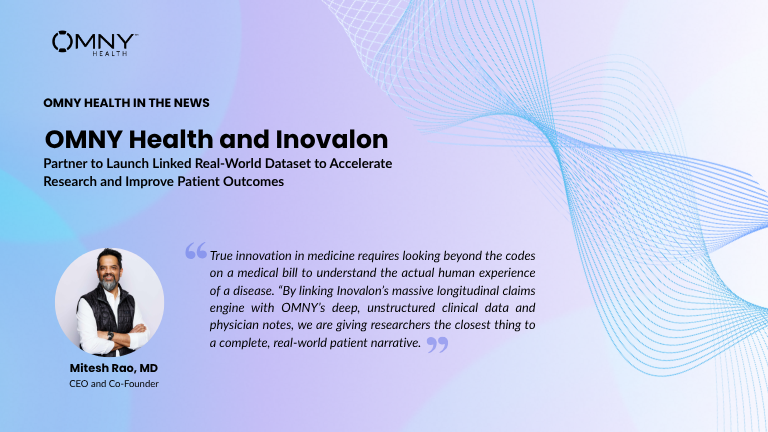
“True innovation in medicine requires looking beyond the codes on a medical bill to understand the actual human experience of a disease,” said Mitesh Rao, M.D., CEO of OMNY Health. “By linking Inovalon’s massive longitudinal claims engine with OMNY’s deep, unstructured clinical data and physician notes, we are giving researchers the closest thing to a complete, real-world patient narrative. This linked dataset bridges a critical gap, allowing life sciences teams to discover meaningful insights faster and accelerate the delivery of precise, life-saving therapies.”
The dataset supports research across any therapeutic area, and the value compounds in complex conditions. For example, with Alzheimer’s disease, patients move between insurance plans as they age and their disease progresses. Claims data maintains continuity across those transitions, while clinical notes capture cognitive decline or improvement, so researchers gain a continuous view of both the care pathway and the underlying disease.
“HEOR teams are under growing pressure to generate evidence that is clinically rich, economically defensible, and compliant,” said Ed Chidsey, President of Inovalon’s RWD & Insights and Payer Business Units. “Inovalon and OMNY are giving researchers a complete de-identified view of the patient along with the clinical and economic insights to drive the next generation of breakthrough research.”
Inovalon and OMNY Health share a commitment to protecting patients and their sensitive health data. Privacy, security, and data quality are foundational to the offering, with de-identification under the HIPAA Expert Determination standard and continuous quality controls applied at every stage of the data lifecycle.
As part of the collaboration, Inovalon has made an undisclosed strategic investment in OMNY Health.
To learn more about Inovalon’s linked real-world dataset and full suite of HEOR and RWE solutions, please visit: https://www.inovalon.com/products/life-sciences/.
About Inovalon
Inovalon is a leading provider of data and solutions empowering data-driven healthcare. We bring together national-scale connectivity, real-time primary source data access, and advanced analytics into a sophisticated platform empowering improved outcomes and economics across the healthcare ecosystem. The company’s analytics and capabilities are used by over 50,000 active, licensed customers, and are informed by the primary source data of more than 99 billion medical events across 1.1 million physicians, 736,000 clinical settings, and 461 million unique lives. For more information, visit www.inovalon.com.
About OMNY Health
OMNY Health™ is the leading healthcare ecosystem for compliant real-world data insights at scale. OMNY Health connects patients, providers, and life sciences companies by transforming vast amounts of de-identified electronic health record data, clinical notes, and claims data into robust, research-ready insights. Leveraging proprietary AI, NLP, and LLM technologies, OMNY Health accelerates therapeutic innovation, optimizes clinical development, and enhances patient care. For more information, visit www.omnyhealth.com.
Contact:
Tom Paolella
AVP, Press and Analyst Relations, Inovalon
OMNY Health Media Contact: media@omnyhealth.com